Pelvic Fractures: Why This Injury Is Never “Wait and See”

Pelvic fractures are among the most serious trauma injuries, often linked to internal bleeding risk. Learn the warning signs and why immediate evaluation is critical.
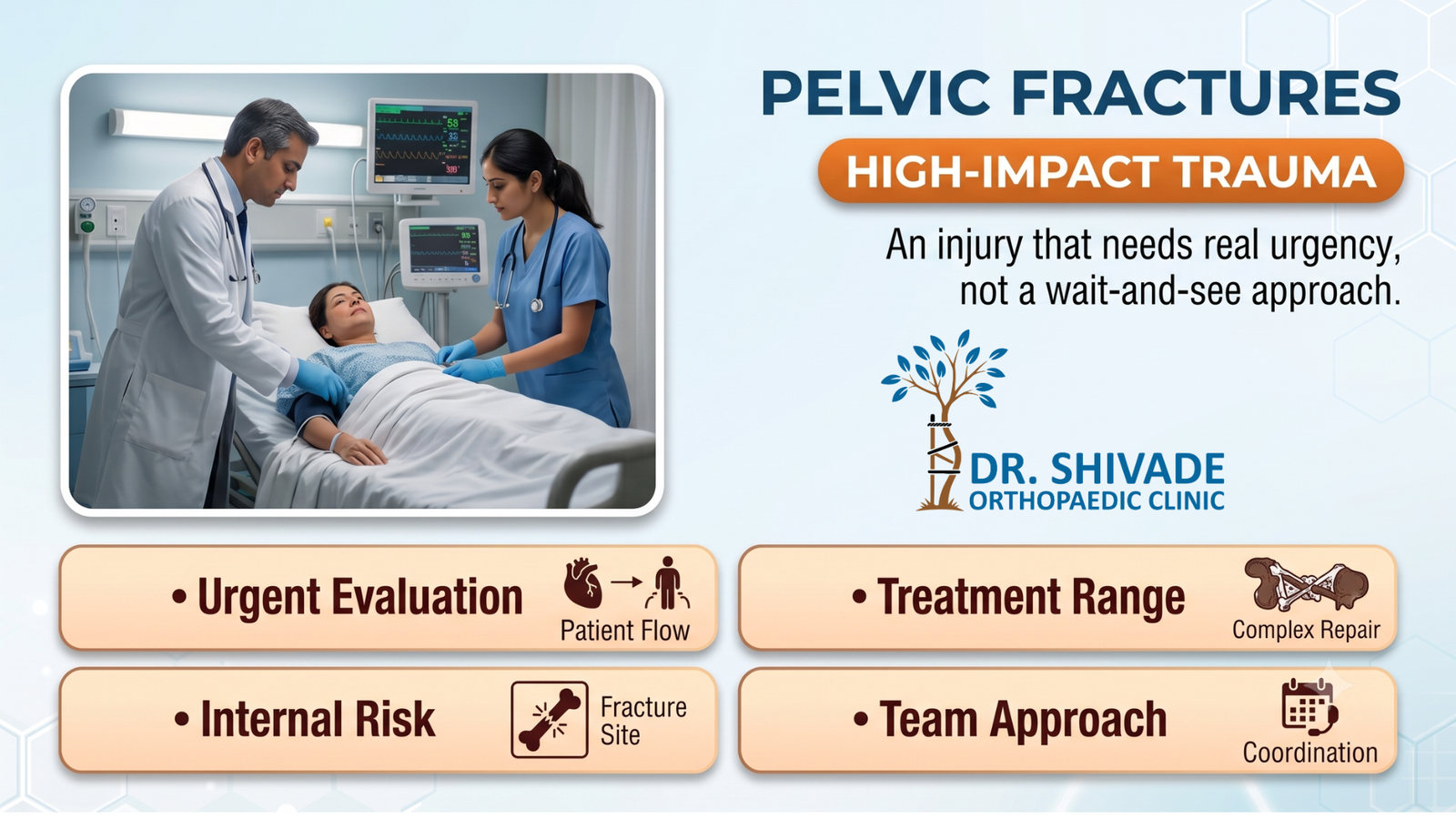
Pelvic fractures are among the most serious injuries treated in trauma care usually from high-impact accidents, and rarely something that presents mildly. This isn’t an injury that gets missed easily, but it’s one that needs to be handled with real urgency.
Why pain here should never be dismissed
Severe pain in the hip, groin, or lower back after a high-impact fall or accident should always be evaluated urgently, even if the person can still move to some degree. The ability to move doesn’t rule out a serious underlying injury.
Why the pelvis needs careful, immediate assessment
Because the pelvis protects major blood vessels and organs, these fractures need immediate, careful assessment beyond just the bone itself. Internal bleeding is a genuine risk that has to be ruled out quickly, making early evaluation critical rather than optional.
How treatment approaches vary
Treatment ranges from supported rest to surgical fixation, depending on how stable the fracture is and whether surrounding structures have also been affected. The right approach depends entirely on the specifics of each case, which is why proper imaging and assessment matter so much.
Why coordinated care is essential
Patients with pelvic fractures often need coordinated care involving more than one specialist, given how closely this part of the body is connected to major organs and blood supply. This kind of multi-specialist approach is often what determines the overall outcome.
Why “wait and see” is never the right call here
This is an injury where “wait and see” is never the right approach. Immediate evaluation is essential, given how much can be at stake beyond the bone injury itself.
Frequently Asked Questions (FAQs)
Yes, in some cases limited movement is still possible, but this doesn't rule out a serious fracture or internal injury — evaluation is still urgently needed regardless of mobility.
The pelvis houses major blood vessels, and fractures here can damage these vessels, leading to significant internal bleeding that isn't always immediately obvious externally.
No — treatment depends on how stable the fracture is. Some stable fractures can be managed with supported rest, while more complex or unstable fractures typically need surgical fixation.
Given the pelvis's proximity to major organs, blood vessels, and the urinary system, coordinated care involving trauma surgeons and other specialists is often needed to manage all aspects of the injury.
Immediately — pelvic fractures should always be treated as urgent, given the risk of internal bleeding and associated complications that can develop rapidly if untreated.