What Actually Happens After Knee Replacement: A Week-by-Week Recovery Guide

Curious what recovery after knee replacement really looks like? Here’s an honest week-by-week timeline from surgery to returning to daily activities.
“What actually happens after knee replacement surgery?” Here’s the honest week-by-week reality we walk patients through before and after their procedure.
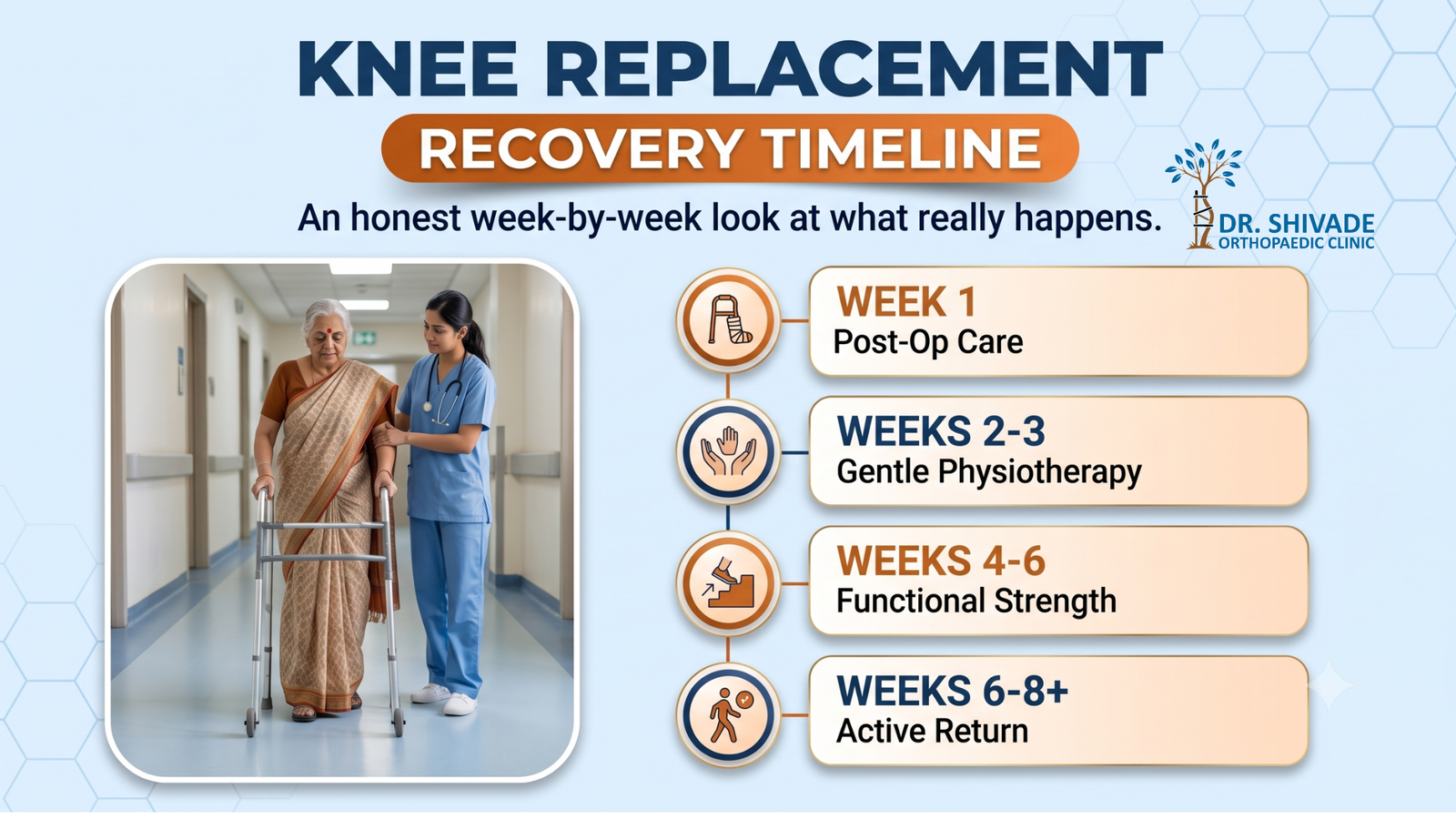
Week 1: Getting started
Walking with a walker or support begins almost immediately, with basic physiotherapy starting within 24 hours of surgery. Some swelling and discomfort are expected during this period, but they’re manageable with prescribed pain relief and proper care.
Week 2–3: Building confidence
Patients typically progress from a walker to a stick during this window. Swelling starts to reduce, bending improves, and most patients notice a clear jump in confidence as mobility returns more naturally.
Week 4–6: Regaining independence
Most patients manage stairs and short walks independently by this stage, with continued strengthening exercises for the surrounding muscles helping to solidify these gains.
Week 6–8: Back to daily life
Return to most daily activities driving, light chores, social outings typically happens in this window, though high-impact activities are usually still restricted at this stage while the joint continues to stabilize.
The single biggest factor in recovery speed
The biggest factor in a smooth recovery isn’t the surgery itself, its consistency with physiotherapy in the first six weeks. Patients who skip sessions almost always take longer to regain full movement, regardless of how well the surgery itself went.
Why this timeline usually reassures patients
If you’re considering surgery and recovery time is your biggest worry, this timeline is usually far more reassuring than expected once patients see it laid out clearly.
Frequently Asked Questions (FAQs)
Most patients begin walking with support, such as a walker, within 24 hours of surgery as part of an early mobilisation protocol designed to speed up recovery.
Most patients can return to driving around the 6–8 week mark, once they've regained sufficient strength, flexibility, and confidence in the operated knee.
Yes, physiotherapy is one of the most important factors in recovery. Skipping sessions in the early weeks is one of the most common reasons recovery slows down.
High-impact activities are usually restricted well beyond the 8-week mark and should only be resumed based on your surgeon's specific guidance and your individual recovery progress.
Yes, recovery isn't perfectly linear, and some days feeling harder than others is a normal part of the process, not necessarily a sign that something is wrong.