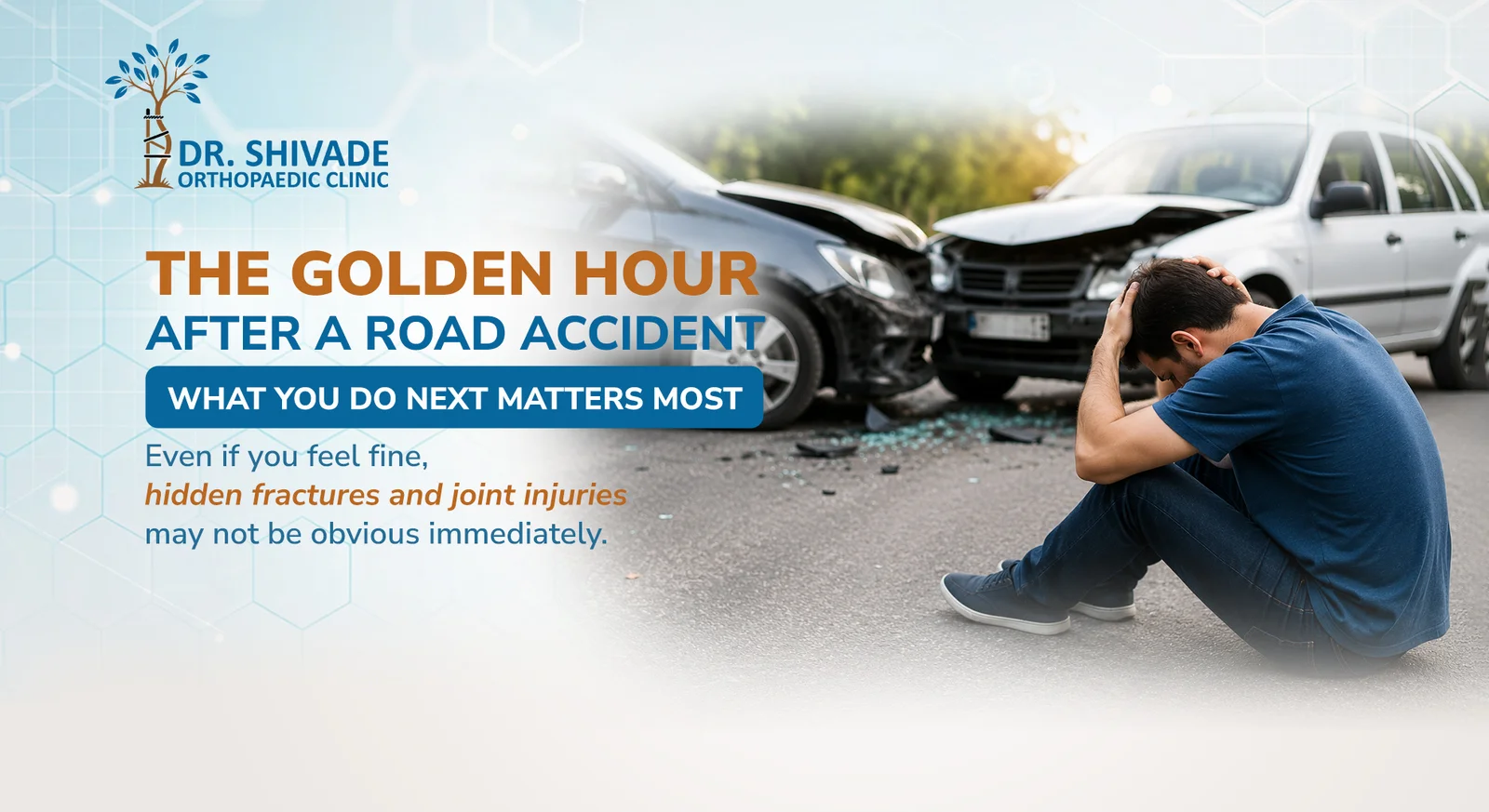
The Golden Hour After a Road Accident: What You Do Next Matters Most

Pune’s traffic never really slows down and neither do the accidents that come with it. A skid on a wet flyover, a sudden brake at a signal, a two-wheeler clipped at an intersection. Most of these accidents don’t look catastrophic from the outside. The person gets up, dusts themselves off, insists they’re “fine,” and heads home.
That’s exactly where the real risk begins.
In trauma care, there’s a concept we take very seriously: the golden hour. It’s the window right after an injury where the right decisions or the wrong ones shape the entire recovery ahead. Not because every accident is life-threatening, but because what happens in that first hour often determines whether a hidden fracture heals cleanly or turns into a complicated, months-long problem.
Why “I Feel Fine” Doesn’t Mean You Are Fine
Adrenaline is a powerful, and often deceptive, thing. In the moments after a fall or a collision, your body floods with it and one of its side effects is that it masks pain. People walk, talk, and even argue with the other driver, all while sitting on a fracture they haven’t discovered yet.
This is why so many patients come to us a day or two after an accident, not immediately after. The soreness that felt manageable on day one becomes sharp, swollen, and impossible to ignore by day two. By then, a simple, non-displaced fracture may have shifted out of position simply because the person kept walking on it, lifting things with it, or sleeping on it awkwardly.
The lesson isn’t to panic after every fall. It’s to stop trusting how you feel in the first hour as an accurate measure of how injured you actually are.
What NOT to Do in the First Few Minutes
Before talking about what helps, it’s worth being clear about what doesn’t.
Don’t move the injured person unnecessarily. Unless there’s immediate danger such as being in the middle of traffic or near a fire, sudden or careless movement can turn a stable fracture into a displaced one, or aggravate a spinal injury that isn’t visible from the outside. The instinct to “help someone up” right after a fall is strong, but it’s often the wrong instinct.
Don’t assume no blood means no injury. Some of the most serious orthopaedic injuries, hairline fractures, ligament tears, internal joint damage leave no visible mark at all. A person can have a fractured wrist or a torn ligament and still look completely uninjured to a bystander.
Don’t let the injured person drive themselves home. This sounds obvious, but it happens constantly. Between the adrenaline masking pain and the shock of the event itself, both judgment and reflexes are compromised, even if the person insists they’re capable.
Don’t wait to “see how it feels tomorrow.” This is the single biggest mistake we see. Waiting doesn’t make an orthopaedic injury less serious; it only delays the point at which it gets treated correctly, giving it more time to get worse.
What the First Hour Should Actually Look Like
- Assess before you act.
Before moving anyone, take a moment to check for obvious deformity, inability to move a limb, or severe pain concentrated in one spot. These are signals that something beyond a bruise may be going on. - Control bleeding, but don’t clean or probe wounds.
If there’s a cut or an open wound near a possible fracture site, apply gentle pressure with a clean cloth. Don’t try to inspect or clean it yourself, that’s a job for a clinical setting, not a roadside. - Immobilize, don’t “test” the injury.
If a limb looks off, is swollen, or the person can’t put weight on it, resist the instinct to “check if it still works” by moving or flexing it. Keep it still and get to a clinic. - Get evaluated the same day even for low-speed accidents.
This is the part people underestimate most. A slow-speed two-wheeler fall or a minor car bump can still cause a hairline fracture, a ligament sprain, or joint damage that doesn’t show obvious symptoms right away. An X-ray or clinical evaluation on the same day catches these early, when treatment is at its simplest.
Why Same-Day Evaluation Changes the Outcome
Here’s a pattern we see over and over: two patients come in with what looks like an identical injury from an identical kind of fall. One comes on the same day. The other waited three or four days because “it didn’t seem that bad.”
The first patient often needs nothing more than a brace, some rest, and a straightforward recovery plan. The second patient, by the time they come in, may have a fracture that’s shifted slightly, swelling that’s harder to bring down, or a ligament injury that’s had time to stiffen and scar in a less-than-ideal position. The treatment is no longer as simple and neither is the recovery timeline.
This is the entire logic behind the golden hour. It isn’t about creating panic around every fall. It’s about recognizing that orthopaedic injuries are far easier, faster, and less expensive to treat when caught early and far harder to fix once time has let them settle into place incorrectly.
A Simple Rule to Remember
If you or someone you know has been in a road accident, even a “minor” one don’t use pain as your only guide for whether it’s serious. Use time instead. Get evaluated the same day, regardless of how the person feels in that first hour.
The golden hour isn’t about speed for the sake of speed. It’s about giving your body the best possible starting point for recovery, before adrenaline, movement, or simple waiting have a chance to complicate what could otherwise have been a straightforward fix.
Frequently Asked Questions (FAQs)
The "Golden Hour" refers to the critical first 60 minutes immediately following a traumatic road accident. Prompt medical attention and emergency trauma intervention within this window significantly increase survival rates and minimize long-term limb disability.
Ensure your safety first, immediately call emergency medical assistance, keep the victim still to prevent neck/spinal cord damage, apply clean pressure to control severe bleeding, and avoid giving the victim food or liquids until medically cleared.
High-impact traffic accidents often cause hidden compound fractures, joint dislocations, or severe ligament damage obscured by shock. Early orthopedic X-rays and CT scans ensure prompt surgical alignment and prevent joint deformity.
Trauma surgeons perform emergency stabilization, debridement, and rigid internal fixation using specialized titanium plates, screws, or intramedullary rods to accurately realign broken bones and restore vascular function.
Supervised gentle rehabilitation begins within 24 to 48 hours after surgical stabilization once the patient is stable, preserving joint range of motion, muscle strength, and preventing stiffness.